
Connectivity: the PLC-HMI-ERP ecosystem as intelligent infrastructure for roll forming lines
In modern roll forming lines, connectivity between PLC, HMI and ERP is not a technological extra: it is the infrastructure that translates a production order into a traceable finished part, without manual interruptions to the information flow. This article explains how the three-tier architecture adopted by Gasparini works, which integration protocols and formats are used, and why material traceability — from coil to finished part — is becoming a competitive requirement for metal profile manufacturers.
When the machine communicates with the company
In a modern roll forming plant, the quality of the finished product increasingly depends on the consistency of information flowing between systems. A production order that originates in the company ERP and reaches the machine PLC within seconds is part of a well-designed connectivity architecture that is achievable on our roll forming lines.
Yet in practice, many manufacturing companies still manage this flow in a fragmented way: the ERP on one side, the machine on the other, and the operator in between acting as a bridge. The cost of this fragmentation is not always visible in the accounts, but it is felt — in terms of time, errors, and difficulty responding quickly to schedule changes.
This article aims to provide a clear overview of how an integrated PLC-HMI-ERP ecosystem works, what tangible benefits it brings to those who manage or supervise a roll forming line, and how Gasparini approaches this topic in its own plants.
The architecture: three levels in communication
A connected plant is not simply a machine with an internet connection. It is a system structured on distinct levels that communicate with each other in an orderly and bidirectional way.
The management level — ERP or MES
This is the starting point of the information flow. The ERP (or more precisely the MES) informs the plant supervisor (HMI) of the production orders to be executed, providing all the information needed to configure the machine and prioritise production orders. The management system does not directly ‘command’ the machine: it informs the plant supervisor of what to produce and when.
The supervision level — HMI and SPS
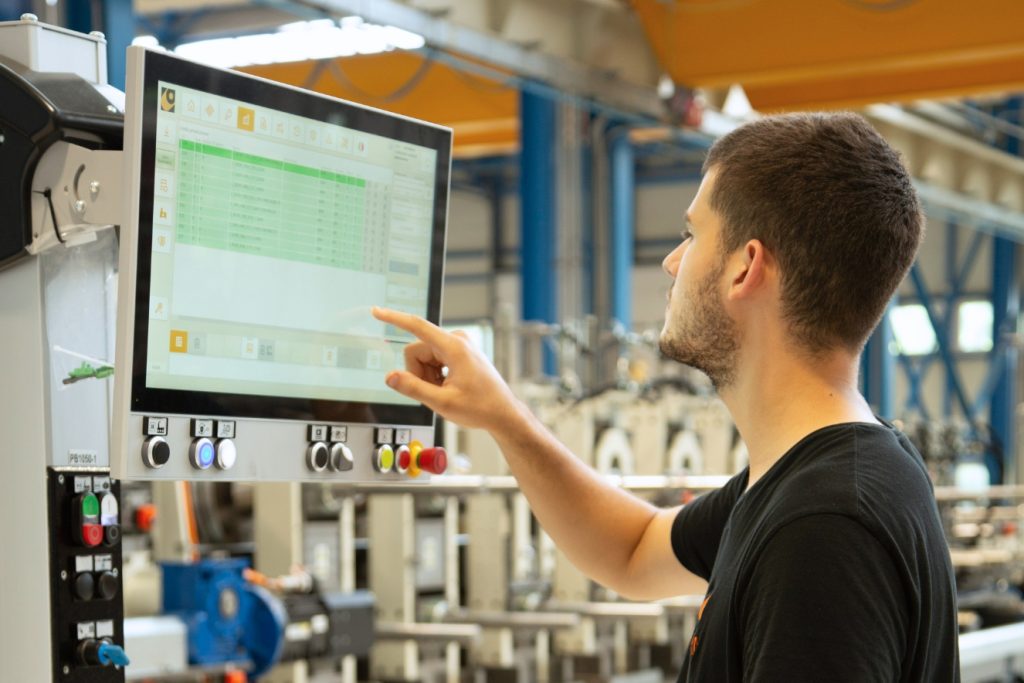
The HMI (Human-Machine Interface) is the interface the operator sees and interacts with. The SPS, with the support of the operator, prepares the actual production schedule for the machine in coordination with the PLC. It is also the point where the operator monitors everything happening on the line in real time: current production, productivity, active alarms, event history, setup parameters — all without stopping the machine.
The control level — PLC
This is the operational core of the plant. The PLC (operated by the operator) first performs the machine setup according to the required production, then coordinates the machine in automatic processing mode to produce individual parts and the required production orders. Once the production orders are complete, the PLC informs the HMI, which in turn reports the production results back to the ERP, along with additional information to evaluate machine productivity and efficiency.
This bidirectional flow — from order to machine, from machine to production report — is what transforms a production line into an intelligent and traceable system.
Real flexibility for all operations integrated in the roll forming line
One of the aspects that distinguishes a mature approach to automation is the ability to coordinate not only the technologies that make up the line, but also third-party machinery that is integrated into it.
The Gasparini PLC programme is structured to coordinate a complete punching/roll forming process, in which sheet metal comes from a coil, is processed, cut and packaged. All individual stages of the process can include Gasparini machinery fully managed by the PLC, or third-party machinery coordinated by the same PLC.
Gasparini roll forming lines incorporate technologies that are interfaced together, such as: decoilers, straighteners, various types of presses, profile welding systems, packaging systems, palletisers, and strapping machines.
This integration capability extends to in-line quality control systems: cameras and 3D laser profilometers — tools increasingly demanded by the market — for those who need to guarantee tight tolerances or document product compliance.
ERP connectivity: formats and flexibility
There is no single standard for connecting a machine to a company’s management system. Production environments vary, as do the installed ERP systems and IT infrastructures.
For this reason, Gasparini’s integration approach is deliberately flexible. The solution is based on a SQL database with predefined data exchange tables, customisable to the specific requirements of each machine. In other cases, the interface has been built using different data exchange formats, such as .xls files, .xml files, text files, or web services and OPC-UA.
This flexibility is a primary technical consideration. For a production manager or IT manager who needs to integrate a new line into an existing company digital ecosystem, knowing that the machine manufacturer can adapt — without requiring changes to the ERP or infrastructure — is a concrete deciding factor.
Material traceability: from coil to finished part
A frequently underestimated aspect when choosing a roll forming line is material traceability. Yet in many application sectors — from construction to automotive, from logistics to electrical distribution — being able to document the origin of each profile produced is an increasingly pressing requirement.
In the data flow managed by Gasparini, material characteristics are an integral part of the input data: for each coil, the ID, material (steel type) and heat code (manufacturer’s lot) are recorded. This information, in addition to being able to influence automation — for example, the steel type must match that required by the production order — is tracked and reported in the output corresponding to the production carried out.
The result is a database that simplifies warehouse management, quality documentation and, in the event of non-conformities, the reconstruction of the material supply chain. It becomes straightforward for the customer to produce production reports useful for warehouse management.
The real value of a connected ecosystem
Ultimately, the question that matters is this: how much is it worth to your company to have a roll forming line that knows what it needs to do, tracks what it has produced, and returns data in the format your management system understands?
The time an operator currently spends manually configuring a machine can range from a few seconds to a few minutes per part, depending on the complexity of the setup. Multiplied by the number of daily setups, this becomes a significant productivity indicator. And this is just one of the visible effects of a well-implemented integration.
The less visible effects — reduction of transcription errors, immediate availability of production data, material traceability — tend to emerge over time, but are often those that make the difference at critical moments: an audit, a complaint, an urgent documentation request from a customer.
Connecting the machine to the company is not only an IT project. It is a strategic industrial decision.