
How the cold roll forming process works

A strategic manufacturing process
Cold roll forming is a continuous plastic deformation process that transforms metal strip into profiles with a constant cross-section. The core of the system consists of a series of shaped rollers that progressively form the sheet metal through multiple passes. At each pass, the material is gradually deformed by a pair of rolls that slightly modifies the geometry until the final profile is achieved. The deformation is incremental in order to avoid excessive stresses and material cracking.
Compared to other sheet metal forming technologies, roll forming stands out for its ability to combine high productivity, dimensional accuracy and maximum efficiency. Unlike bending or blanking, which operate in single, discontinuous stages, roll forming works as a continuous process: this allows the production of profiles with theoretically unlimited length, consistent repeatability and excellent surface finish, directly from the coil.
Since the process takes place at room temperature, the mechanical properties of the material and the integrity of protective coatings are preserved – an advantage over hot forming or methods requiring welding operations. The gradual deformation across multiple stations also reduces residual stresses and springback risk, even when processing high-strength steels.
In modern industry, cold roll forming is not only a forming technology, but a truly strategic manufacturing process, capable of ensuring scalability, automation and consistent quality for a wide range of applications in steel, aluminum and other metals.
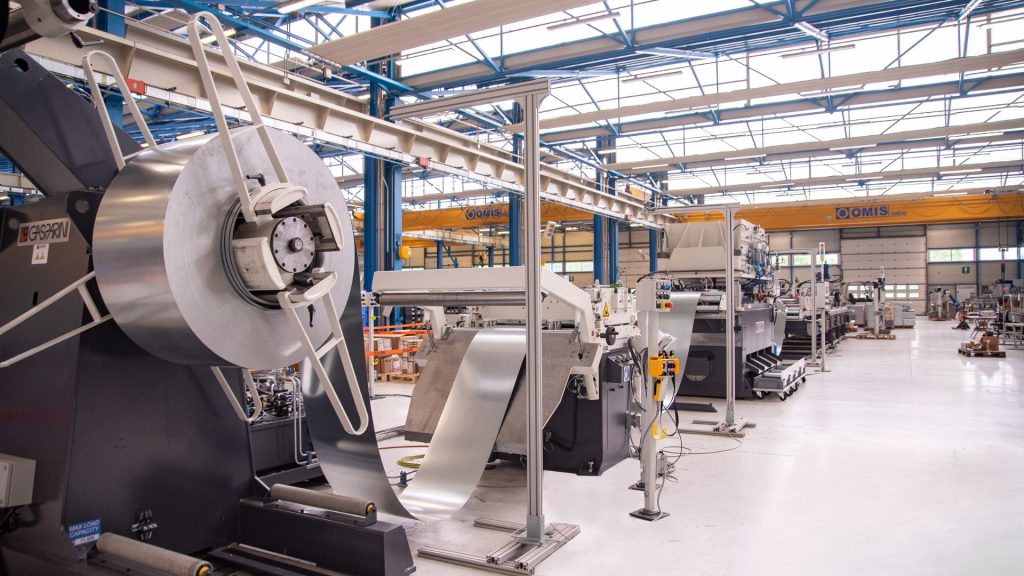
Cold roll forming process overview
Cold roll forming can start from coil or from pre-cut sheets, depending on the profile type and the required downstream operations. The material is guided into the line, where it passes through a sequence of forming stations: each pair of rolls applies a small plastic deformation, gradually achieving the final geometry.
The deformation is progressive and controlled, ensuring uniform stress distribution and maintaining very tight dimensional tolerances. The profile can be cut to length either before or after forming, providing maximum process flexibility. In addition, it can undergo further operations through integrated punching, drilling, clinching or welding units, performed upstream or downstream of the roll forming process without interrupting production flow.
This continuous sequence of operations enables the production of complex, precise and repeatable profiles, with high productivity and consistent quality—features that make cold roll forming one of the most efficient technologies for processing thin sheets and metal strips.
Advantages of cold roll forming
Cold roll forming offers a combination of productivity, precision and geometric flexibility that is difficult to achieve with other sheet metal forming processes. The principle of progressive deformation allows the production of complex profiles with variable lengths, which can exceed several meters, while maintaining a constant cross-section and high repeatability between parts.
Moreover, roll forming ensures greater process continuity: the material advances steadily through the line, eliminating idle times and reducing labor and handling costs. The use of coil-fed material also ensures high material efficiency, with reduced scrap and improved resource utilization.
Cold deformation preserves the mechanical and surface characteristics of the base material, avoiding heat-induced alterations. This makes the process ideal for high-strength, galvanized, pre-painted steels or materials with specific coatings.
Finally, the possibility of integrating punching, cutting, clinching or welding operations in-line allows finished components to be obtained directly at the end of the roll forming process. This reduces secondary operations and ensures uniform quality across the entire production.
Achievable profiles and typical applications
Cold roll forming allows the production of a wide variety of cross-sections – from simple profiles to complex geometries – with tight tolerances and repeatability over long lengths. In production environments, lines equipped with modular tooling and interchangeable stations enable switching between C, U, Z, omega and sigma profiles. Roofing and composite deck systems allow changes between up to four panel types. While lines for structural components used in shop and industrial shelving are integrated with production islands for reinforcement assembly and fastening.
Gasparini has developed solutions for highly diversified metal profile production. Among the most requested lines:
- Shelving sections and mezzanine structures: profiles with brackets and reinforcements welded directly in-line. Integrated lines combining roll forming, punching, bending and welding deliver finished components without additional manual operations.
- Construction and photovoltaic structures: high-productivity lines for structural profiles and uprights. These systems are capable of automatically adapting to different section geometries and changes in base, height and thickness with unloading systems featuring programmable stacking patterns and integrated strapping systems.
- Roofing and cladding profiles: galvanized or pre-painted sheets transformed into corrugated panels or composite decking. Gasparini “REVOLVER” lines enable rapid changeovers between different sections with minimal downtime, flying cut and the possibility to produce overlap edges and embossing operations.
- Cable trays and ladders: specialized “TWIN” lines for the production of trays and covers up to 600 mm wide, with integrated punching and end-expansion modules.
- Pipes and gutters for sheet metal work: roll forming lines integrating seaming, welding and tapering directly in-line as implemented in Gasparini roll forming systems for downpipes
- Components for armored door frames and sliding gates: PRO systems designed to produce high-precision frames and counter frames ready for final assembly, with automated bracket application, cutting, curving and integrated punching units.


In terms of materials, the lines are designed to process sheets from 0.2 up to 12 mm / 39 gauge up to 0.47 in thickness (depending on the project) and can handle pickled, galvanized, pre-painted steels and aluminum.
For customers, this translates into:
- High geometric flexibility: the ability to produce complex or customized profiles without compromising efficiency.
- Reduction of processing stages: thanks to in-line integration of punching, welding and cutting, external manual operations or transfers between machines are avoided.
- Applications across multiple sectors: from construction and roofing, to energy, logistics and automotive – each profile is developed based on the specific technical requirements of the customer.
Differences compared to other forming technologies
When compared with the main sheet metal forming technologies, cold roll forming stands out for its ability to combine process continuity, dimensional stability and production efficiency.
Unlike bending, which produces a single bend per cycle and requires dedicated tooling for each geometry, roll forming enables the production of complex profiles in a single continuous pass, with significantly shorter cycle times and a higher level of automation.
Compared to stamping or deep drawing, which involve concentrated deformation and high material stress, roll forming distributes deformation across multiple stations, preventing loss of flatness. This makes it possible to process high-strength and pre-painted steels while preserving mechanical and surface integrity.
In comparison with extrusion, roll forming offers significant advantages in terms of cost and speed, especially for steel profiles. Extrusion is more suitable for light alloys or complex closed sections, but it requires higher energy consumption and cooling times.
Finally, in comparison with welding bent elements, roll forming drastically reduces the number of operations and joining points, improving both the aesthetic and structural quality of the component.
In summary, cold roll forming represents an ideal balance between geometric precision, productivity and flexibility, making it an optimal solution for medium- to high-volume production of metal profiles for structural, logistics and industrial sectors.
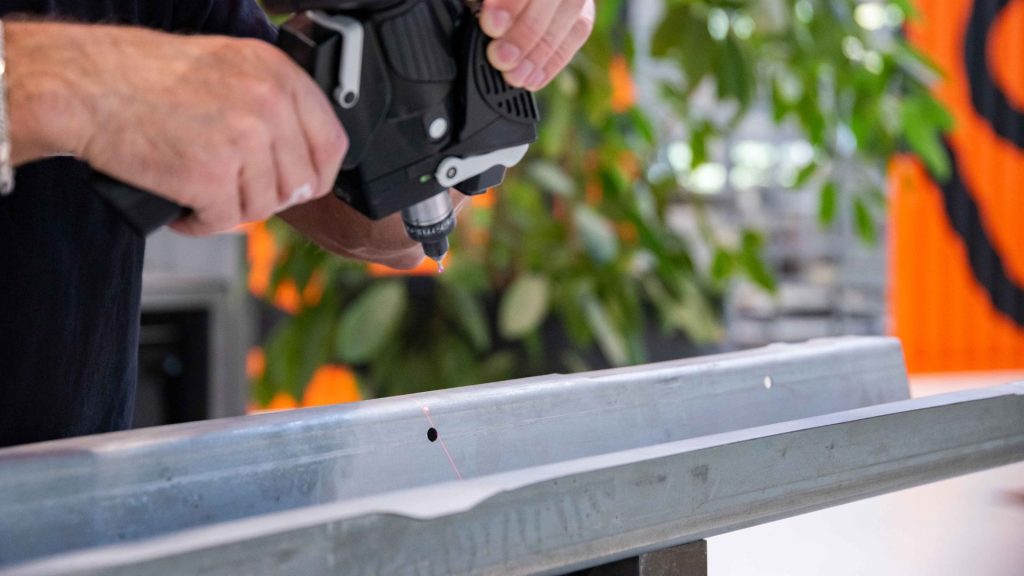
Process optimization and profile reliability
Gasparini roll forming lines ensure compliant profiles and optimized processes through continuous monitoring systems and automatic adjustments.
Tools such as optical inspection systems, flatness controls and dimensional measuring devices enable precise geometry verification.
The modularity of the lines allows targeted interventions on specific stations or tooling, reducing downtime and ensuring production continuity.
This integrated approach makes Gasparini roll forming a reliable, precise and fully controlled process, capable of delivering complex metal profiles with consistent quality and high efficiency.
Take your roll forming to the next level
Do you need to improve quality, production continuity or automation in your metal profile manufacturing?
Send us your profile details: our technical team will evaluate the most efficient solution to increase precision, productivity and reliability in your production.
Request a personalized analysis of your project now. Fill in the form and speak with our experts.